Automakers that miss emissions standards under Australia’s New Vehicles Efficiency Standard (NVES) will be named and shamed in 2026. The NVES was introduced on January 1, 2025, with fines coming into force from July 1, 2025, for brands exceeding pre-set carbon-dioxide (CO2) emissions limits across their model lineups. The first ‘performance period’ commenced on January 1, 2025, and ends on December 31, 2025. The NVES Regulator says it will publish the interim result, which it terms ‘interim emissions value’ (IEV) for this period in February 2026. CarExpert can save you thousands on a new car. Click here to get a great deal.…

-
-
A Chevrolet Corvette Grand Sport could be on the way to showrooms with a new 6.7-litre LS6 V8 engine, the largest-capacity engine to be used in the current generation C8. Reports from Road & Track cite Corvette Blogger discovering the new engine, codenamed ‘LS6’, in the same parts book where the ZR1 Corvette’s LT7 V8 was spotted before its official 2024 reveal. While the engine has not been officially confirmed by Chevrolet, GM Performance lead engineer Tony Roma told Top Gear earlier this year at the launch of the flagship ZR1X there were more ‘hot’ C8 Corvettes to come. The…
-
In this tutorial, we build an end-to-end, production-style agentic workflow using GraphBit that demonstrates how graph-structured execution, tool calling, and optional LLM-driven agents can coexist in a single system. We start by initializing and inspecting the GraphBit runtime, then define a realistic customer-support ticket domain with typed data structures and deterministic, offline-executable tools. We show how these tools can be composed into a reliable, rule-based pipeline for classification, routing, and response drafting, and then elevate that same logic into a validated GraphBit workflow in which agent nodes orchestrate tool usage via a directed graph. Throughout the tutorial, we keep the…
-
In this tutorial, we build an end-to-end, production-style agentic workflow using GraphBit that demonstrates how graph-structured execution, tool calling, and optional LLM-driven agents can coexist in a single system. We start by initializing and inspecting the GraphBit runtime, then define a realistic customer-support ticket domain with typed data structures and deterministic, offline-executable tools. We show how these tools can be composed into a reliable, rule-based pipeline for classification, routing, and response drafting, and then elevate that same logic into a validated GraphBit workflow in which agent nodes orchestrate tool usage via a directed graph. Throughout the tutorial, we keep the…
-
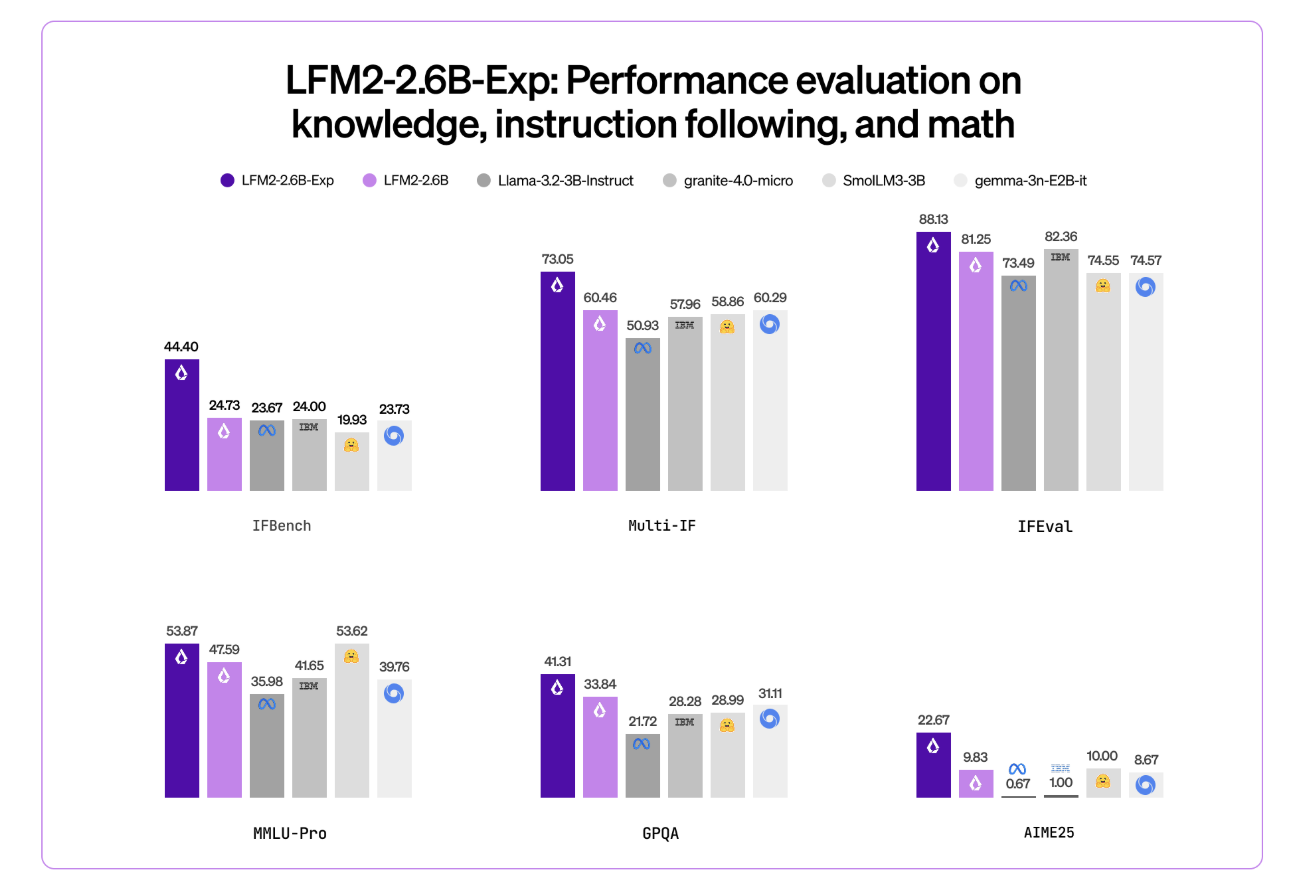
Liquid AI has introduced LFM2-2.6B-Exp, an experimental checkpoint of its LFM2-2.6B language model that is trained with pure reinforcement learning on top of the existing LFM2 stack. The goal is simple, improve instruction following, knowledge tasks, and math for a small 3B class model that still targets on device and edge deployment. Where LFM2-2.6B-Exp Fits in the LFM2 Family? LFM2 is the second generation of Liquid Foundation Models. It is designed for efficient deployment on phones, laptops, and other edge devices. Liquid AI describes LFM2 as a hybrid model that combines short range LIV convolution blocks with grouped query attention…
-
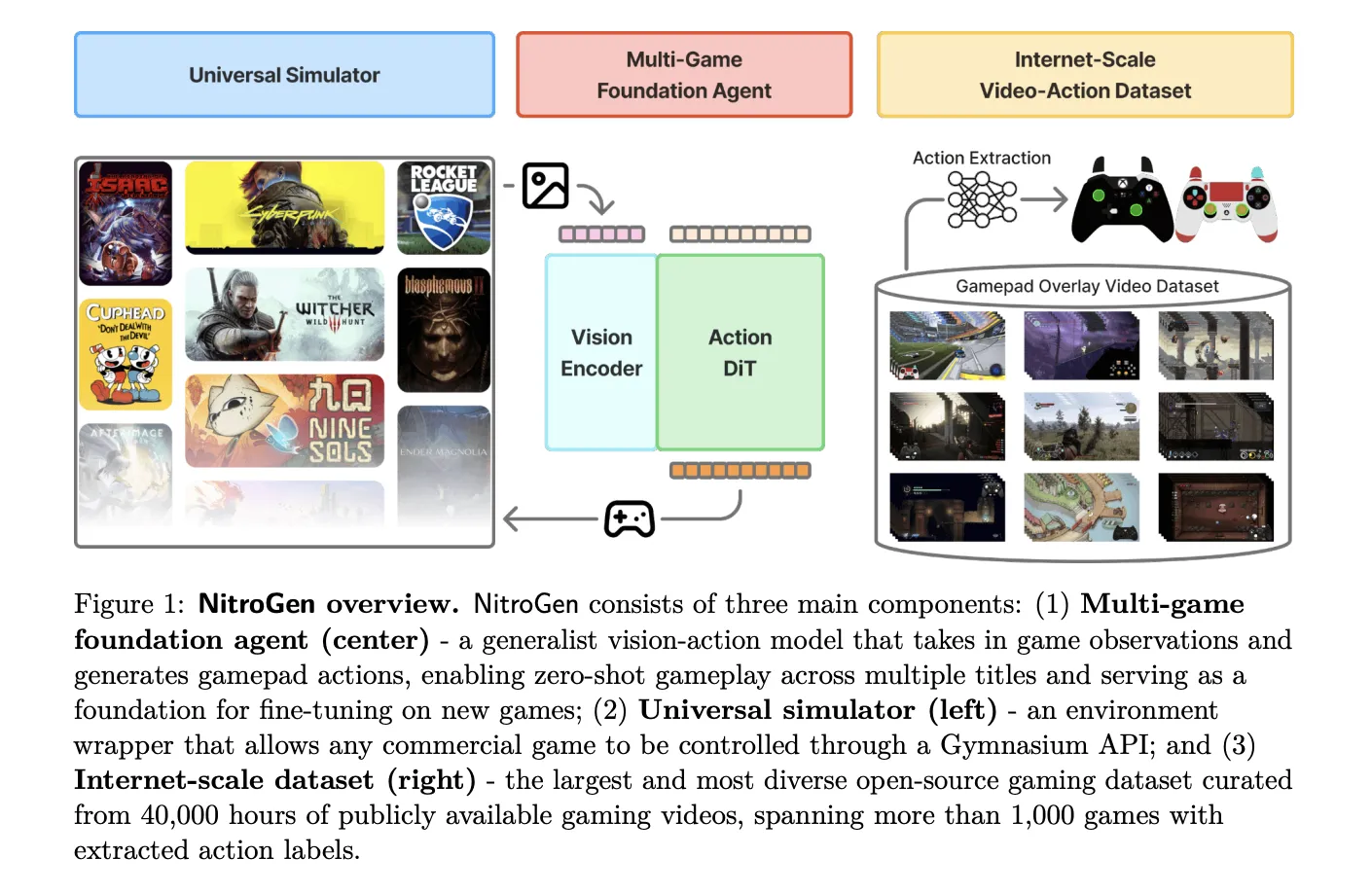
NVIDIA AI research team released NitroGen, an open vision action foundation model for generalist gaming agents that learns to play commercial games directly from pixels and gamepad actions using internet video at scale. NitroGen is trained on 40,000 hours of gameplay across more than 1,000 games and comes with an open dataset, a universal simulator, and a pre trained policy. https://nitrogen.minedojo.org/assets/documents/nitrogen.pdf Internet scale video action dataset The NitroGen pipeline starts from publicly available gameplay videos that include input overlays, for example gamepad visualizations that streamers place in a corner of the screen. The research team collects 71,000 hours of raw…
-
NVIDIA AI research team released NitroGen, an open vision action foundation model for generalist gaming agents that learns to play commercial games directly from pixels and gamepad actions using internet video at scale. NitroGen is trained on 40,000 hours of gameplay across more than 1,000 games and comes with an open dataset, a universal simulator, and a pre trained policy. https://nitrogen.minedojo.org/assets/documents/nitrogen.pdf Internet scale video action dataset The NitroGen pipeline starts from publicly available gameplay videos that include input overlays, for example gamepad visualizations that streamers place in a corner of the screen. The research team collects 71,000 hours of raw…
-
In this tutorial, we demonstrate how to design a contract-first agentic decision system using PydanticAI, treating structured schemas as non-negotiable governance contracts rather than optional output formats. We show how we define a strict decision model that encodes policy compliance, risk assessment, confidence calibration, and actionable next steps directly into the agent’s output schema. By combining Pydantic validators with PydanticAI’s retry and self-correction mechanisms, we ensure that the agent cannot produce logically inconsistent or non-compliant decisions. Throughout the workflow, we focus on building an enterprise-grade decision agent that reasons under constraints, making it suitable for real-world risk, compliance, and governance…
-
The mania around data centers has a lot of companies looking to become “picks and shovels” providers, by building profitable businesses that are ancillary to the gold rush gigs of selling server access or training leading AI models. MayimFlow, the Built World stage winner at this year’s TechCrunch Disrupt, is a good example. The startup is focused on essentially one task: preventing damaging water leaks. Data centers use a lot of water, and that water can present a big risk, even if a leak is small. Founder John Khazraee told TechCrunch that many data centers only have reactive solutions for…
-
One of the founders of WeTransfer — a popular free file-sharing service used by millions worldwide — is publicly criticizing the company’s new direction. Dutch entrepreneur Nalden, who co-founded the platform in 2009, says he’s deeply unhappy with changes made since Bending Spoons — a Milan-based tech firm known for buying and restructuring popular apps — acquired the service last year. “Bending Spoons doesn’t really care about people. Even though I get that it is their private equity strategy, I notice that since I left [WeTransfer] in 2019, there were a lot of updates that were basically killing the product,…