Google has released FunctionGemma, a specialized version of the Gemma 3 270M model that is trained specifically for function calling and designed to run as an edge agent that maps natural language to executable API actions. But, What is FunctionGemma? FunctionGemma is a 270M parameter text only transformer based on Gemma 3 270M. It keeps the same architecture as Gemma 3 and is released as an open model under the Gemma license, but the training objective and chat format are dedicated to function calling rather than free form dialogue. The model is intended to be fine tuned for specific function…
-
-
In this tutorial, we build an end-to-end, production-style agentic workflow using GraphBit that demonstrates how graph-structured execution, tool calling, and optional LLM-driven agents can coexist in a single system. We start by initializing and inspecting the GraphBit runtime, then define a realistic customer-support ticket domain with typed data structures and deterministic, offline-executable tools. We show how these tools can be composed into a reliable, rule-based pipeline for classification, routing, and response drafting, and then elevate that same logic into a validated GraphBit workflow in which agent nodes orchestrate tool usage via a directed graph. Throughout the tutorial, we keep the…
-
In this tutorial, we build an end-to-end, production-style agentic workflow using GraphBit that demonstrates how graph-structured execution, tool calling, and optional LLM-driven agents can coexist in a single system. We start by initializing and inspecting the GraphBit runtime, then define a realistic customer-support ticket domain with typed data structures and deterministic, offline-executable tools. We show how these tools can be composed into a reliable, rule-based pipeline for classification, routing, and response drafting, and then elevate that same logic into a validated GraphBit workflow in which agent nodes orchestrate tool usage via a directed graph. Throughout the tutorial, we keep the…
-
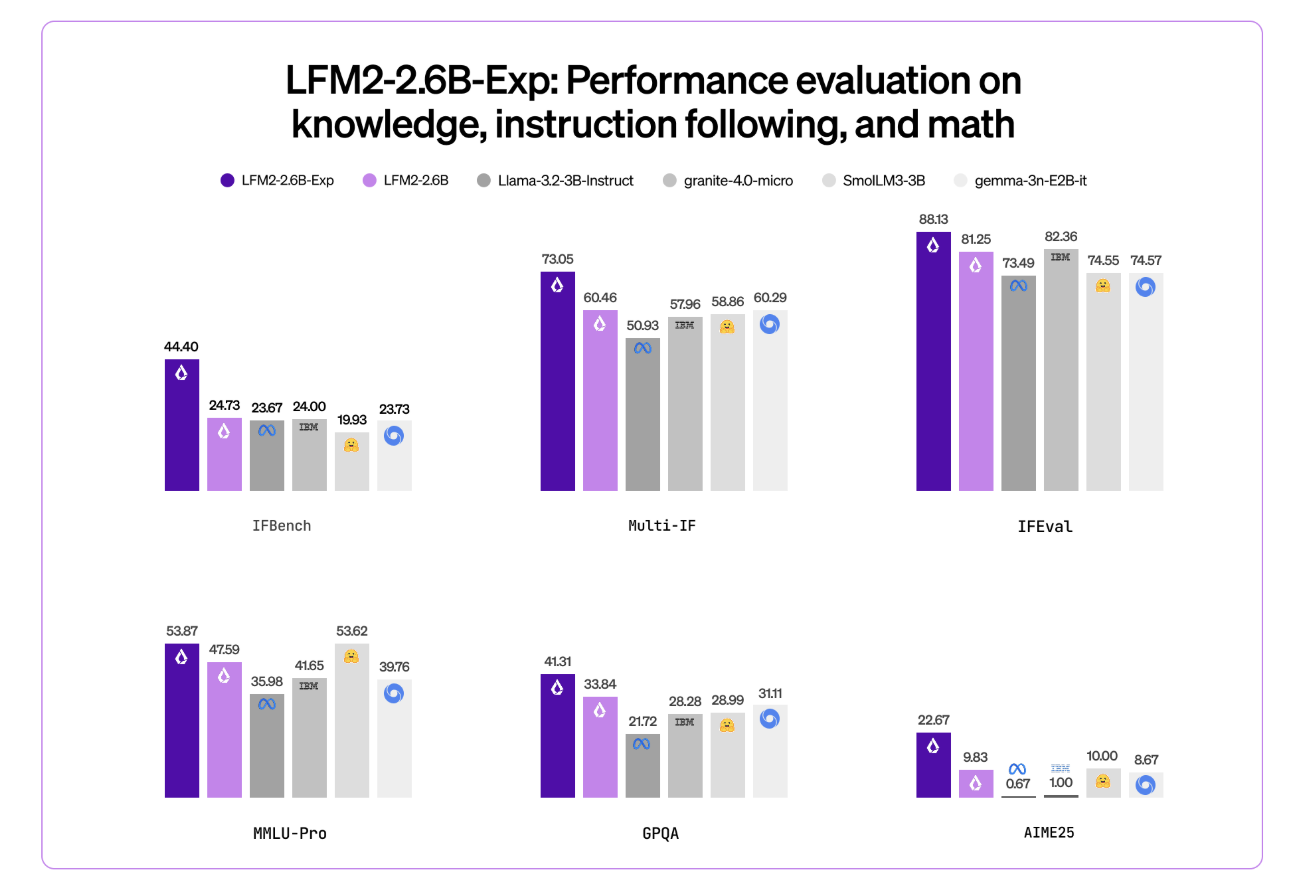
Liquid AI has introduced LFM2-2.6B-Exp, an experimental checkpoint of its LFM2-2.6B language model that is trained with pure reinforcement learning on top of the existing LFM2 stack. The goal is simple, improve instruction following, knowledge tasks, and math for a small 3B class model that still targets on device and edge deployment. Where LFM2-2.6B-Exp Fits in the LFM2 Family? LFM2 is the second generation of Liquid Foundation Models. It is designed for efficient deployment on phones, laptops, and other edge devices. Liquid AI describes LFM2 as a hybrid model that combines short range LIV convolution blocks with grouped query attention…
-
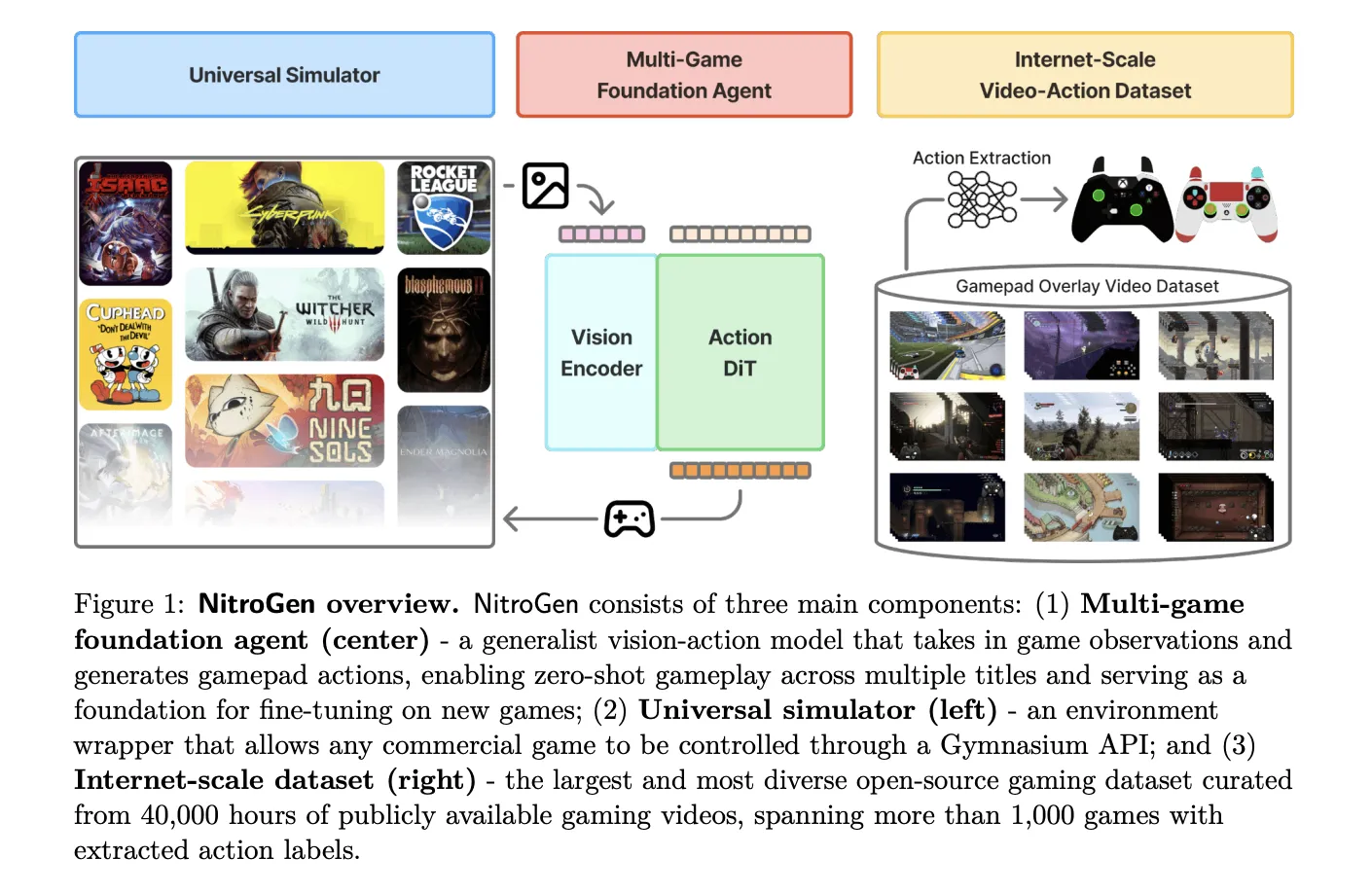
NVIDIA AI research team released NitroGen, an open vision action foundation model for generalist gaming agents that learns to play commercial games directly from pixels and gamepad actions using internet video at scale. NitroGen is trained on 40,000 hours of gameplay across more than 1,000 games and comes with an open dataset, a universal simulator, and a pre trained policy. https://nitrogen.minedojo.org/assets/documents/nitrogen.pdf Internet scale video action dataset The NitroGen pipeline starts from publicly available gameplay videos that include input overlays, for example gamepad visualizations that streamers place in a corner of the screen. The research team collects 71,000 hours of raw…
-
NVIDIA AI research team released NitroGen, an open vision action foundation model for generalist gaming agents that learns to play commercial games directly from pixels and gamepad actions using internet video at scale. NitroGen is trained on 40,000 hours of gameplay across more than 1,000 games and comes with an open dataset, a universal simulator, and a pre trained policy. https://nitrogen.minedojo.org/assets/documents/nitrogen.pdf Internet scale video action dataset The NitroGen pipeline starts from publicly available gameplay videos that include input overlays, for example gamepad visualizations that streamers place in a corner of the screen. The research team collects 71,000 hours of raw…
-
In this tutorial, we demonstrate how to design a contract-first agentic decision system using PydanticAI, treating structured schemas as non-negotiable governance contracts rather than optional output formats. We show how we define a strict decision model that encodes policy compliance, risk assessment, confidence calibration, and actionable next steps directly into the agent’s output schema. By combining Pydantic validators with PydanticAI’s retry and self-correction mechanisms, we ensure that the agent cannot produce logically inconsistent or non-compliant decisions. Throughout the workflow, we focus on building an enterprise-grade decision agent that reasons under constraints, making it suitable for real-world risk, compliance, and governance…