• NVIDIA AI Researchers Release NitroGen: An Open Vision Action Foundation Model For Generalist Gaming Agents

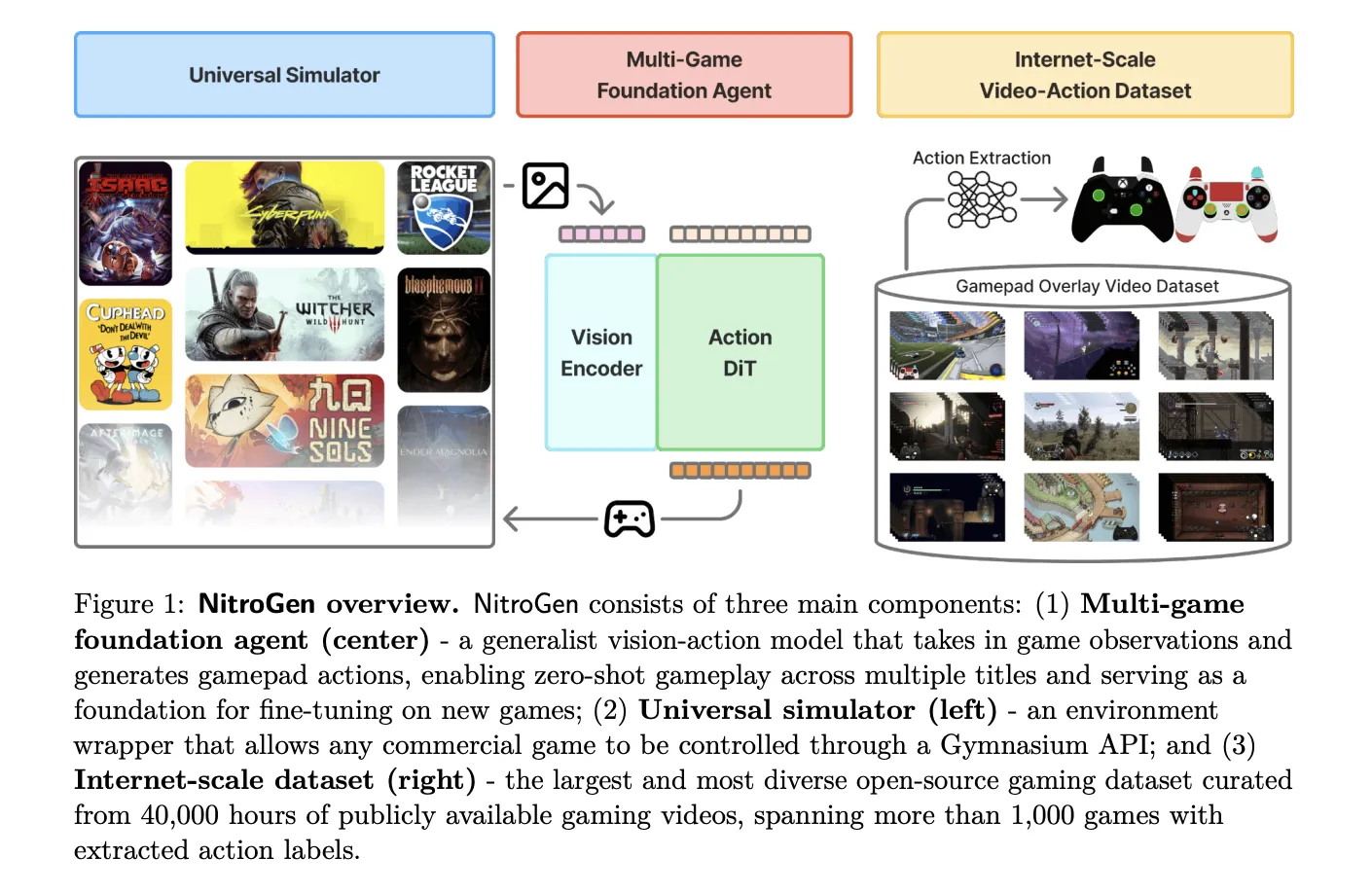
    NVIDIA AI research team released NitroGen, an open vision action foundation model for generalist gaming agents that learns to play commercial games directly from pixels and gamepad actions using internet video at scale. NitroGen is trained on 40,000 hours of gameplay across more than 1,000 games and comes with an open dataset, a universal simulator, and a pre trained policy. https://nitrogen.minedojo.org/assets/documents/nitrogen.pdf Internet scale video action dataset The NitroGen pipeline starts from publicly available gameplay videos that include input overlays, for example gamepad visualizations that streamers place in a corner of the screen. The research team collects 71,000 hours of raw…
  • NVIDIA AI Researchers Release NitroGen: An Open Vision Action Foundation Model For Generalist Gaming Agents

    NVIDIA AI research team released NitroGen, an open vision action foundation model for generalist gaming agents that learns to play commercial games directly from pixels and gamepad actions using internet video at scale. NitroGen is trained on 40,000 hours of gameplay across more than 1,000 games and comes with an open dataset, a universal simulator, and a pre trained policy. https://nitrogen.minedojo.org/assets/documents/nitrogen.pdf Internet scale video action dataset The NitroGen pipeline starts from publicly available gameplay videos that include input overlays, for example gamepad visualizations that streamers place in a corner of the screen. The research team collects 71,000 hours of raw…

  • How to Build Contract-First Agentic Decision Systems with PydanticAI for Risk-Aware, Policy-Compliant Enterprise AI

    In this tutorial, we demonstrate how to design a contract-first agentic decision system using PydanticAI, treating structured schemas as non-negotiable governance contracts rather than optional output formats. We show how we define a strict decision model that encodes policy compliance, risk assessment, confidence calibration, and actionable next steps directly into the agent’s output schema. By combining Pydantic validators with PydanticAI’s retry and self-correction mechanisms, we ensure that the agent cannot produce logically inconsistent or non-compliant decisions. Throughout the workflow, we focus on building an enterprise-grade decision agent that reasons under constraints, making it suitable for real-world risk, compliance, and governance…